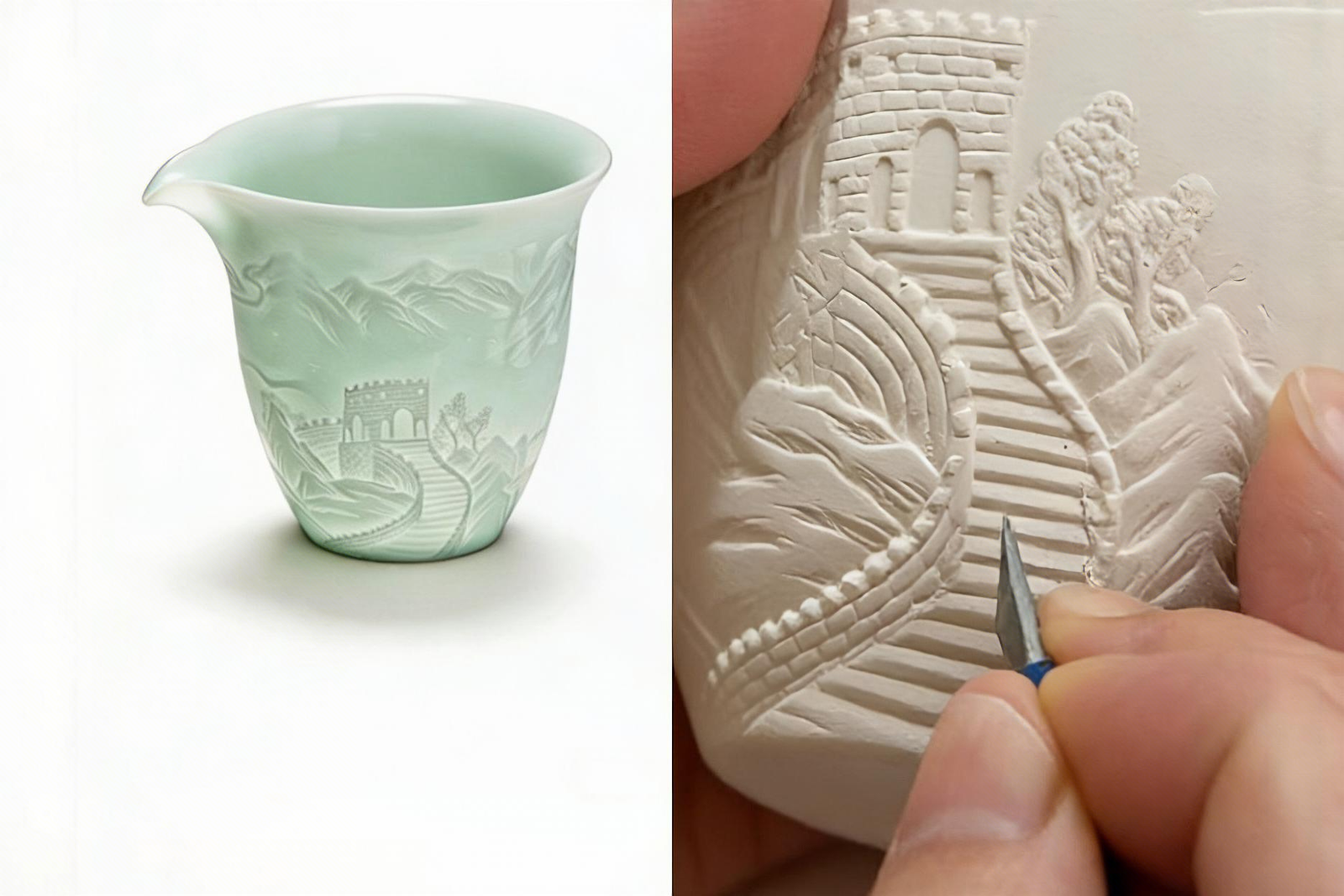
Half-carving is a traditional ceramic carving technique that originated in Jingdezhen. Using iron carving tools, artisans create linear patterns of varying depths on the ceramic body. After glazing and high-temperature firing, these patterns take on a translucent quality, producing a visual effect described as “as clear as ice and as pure as jade.”
Half-carving involves using iron carving tools to create grooves and lines of varying depths on a dry clay form, producing patterns with a strong sense of depth and transparency. The process can be summarized as follows:
Design and Transfer: Artisans create traditional motifs—such as flowers, birds, and landscapes—based on the shape of the vessel, then transfer these designs onto the dry ceramic surface. Carving (Core Technique): This is the essence of “half-cut” clay. Artisans use specialized iron engraving tools to carve the clay surface using the “half-cut” technique. The strokes emphasize alternating depths; by controlling the angle and pressure of the tool, they achieve rich tonal contrasts and three-dimensional depth in a single pass—resulting in lines that are sharply defined on one side and subtly recessed on the other. This step requires extraordinary precision and consistency. Engraving and Sculpting: Building upon the engraving, techniques such as “carving” (removing excess clay) and “sculpting” (defining fine details) are sometimes employed to further enhance the design’s complexity and depth, making it more vivid and fluid.
Glazing: After drying, the carved ceramic pieces are coated with a transparent glaze (for standard semi-carved porcelain) or a blue-and-white glaze (for blue-and-white semi-carved porcelain). The transparent glaze preserves the pure white hue of the clay and the translucent beauty of the carved patterns to the fullest extent; the blue-and-white glaze interacts with the carvings to create a striking visual effect. High-Temperature Firing: The glazed ceramic pieces are placed in a kiln and fired at a temperature of approximately 1300°C. At such extreme temperatures, the glaze melts, enveloping and protecting the carved patterns. This process creates a unique artistic effect reminiscent of ice or jade, with the design faintly visible beneath the glaze. resulting in a delicate and translucent texture。 In summary, the half-carved ceramic craft involves the following steps: design → sculpting (core: half-carved ceramic technique) → glazing → high-temperature firing. Its artistic appeal lies in the seamless fusion of three-dimensional sculptural effects with the warm tones and luster of the ceramic glaze, representing a form of ceramic decorative art deeply rooted in Eastern aesthetics.